
Broken In with Prayer
Some Thoughts on My Used BCP (Book of Common Prayer)

Christmas
1984
Many thanks, Billy John, for your year as Senior Warden. Use this Prayer Book toward good spiritual health in Church and world–
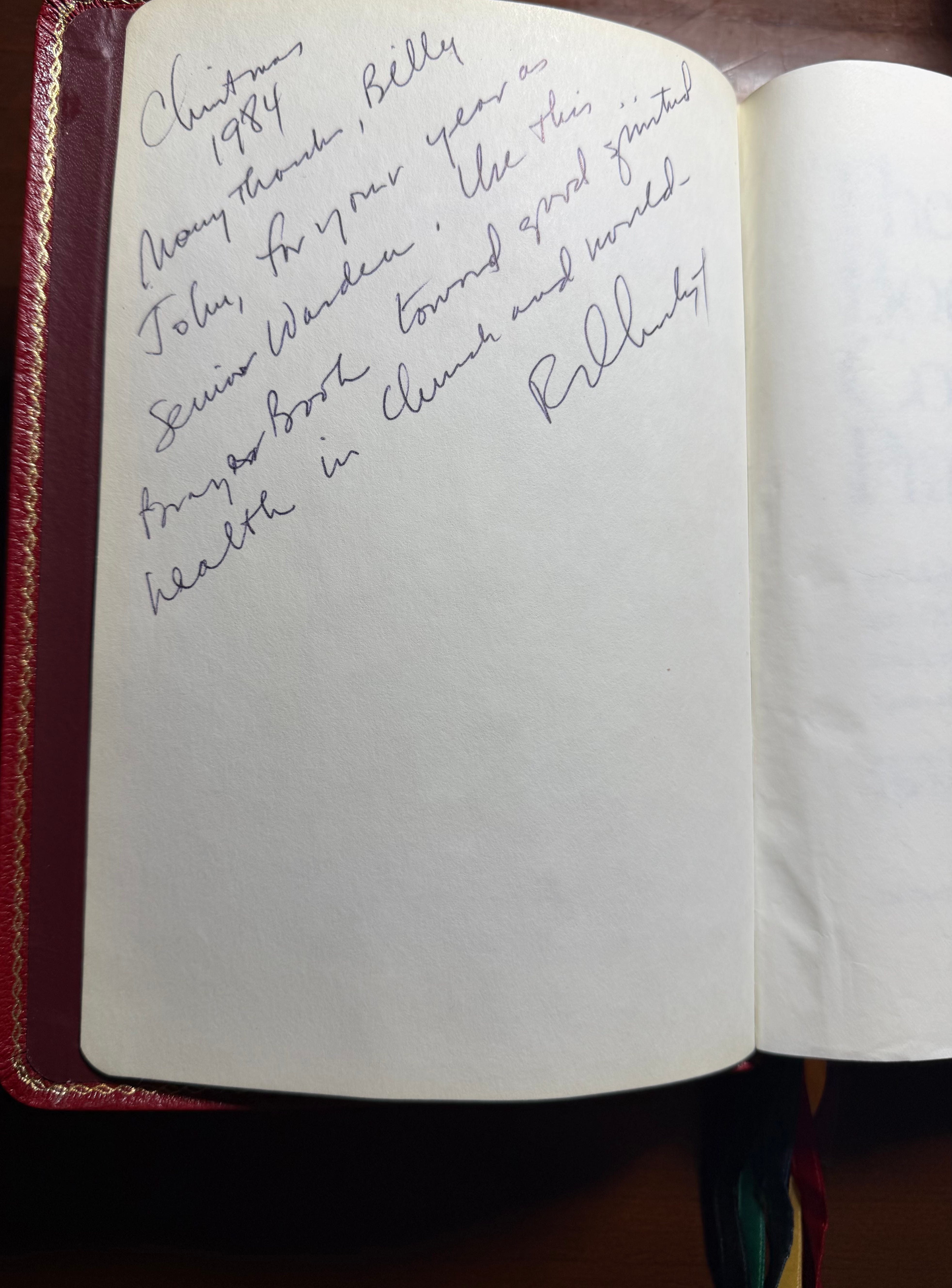
On Christmas Day, my wife told me she still had a gift to give me that had not arrived. On December 27th, it came. I have a pocket-sized BCP (Book of Common Prayer), but I have been looking for a regular-sized BCP with ribbons. Marisa found a beautiful, perfectly sized leather BCP with 6 ribbons. It’s exactly what I’ve been looking for.
Sometimes it’s nice to have something new, something no one has used before. Like a new car, I suppose. But sometimes it’s better to have something that’s already been broken in. It’s a bit boujee, but I generally like new books. I like and buy used books too, but I’m quite picky about them. They can’t be heavily marked, for example. And no one in their right mind would want one of my books second-hand. I highlight and notate like a man with a problem. But I feel differently about my lightly marked BCP. I’m glad it’s used, instead of new.
There is more going on in this life than we can imagine. Far more. I’m enough of a mystic to believe that prayer changes not just people, but the places prayed in, too. Henri Nouwen once wrote,
“I find it easier to pray in places where people have prayed long before, and harder to pray in places where seldom a prayer has been uttered.”1
Have you ever walked into a space and known, somehow, that you were on holy ground? Perhaps a church? Or a monastery? Or even the woods, or the coast? That the ground, or the pews, or the walls held something sacred and unseen? A place soaks up the prayers prayed there and holds the memory of encounter. Holds the longings felt, met, and expanded.
I don’t know who Billy John was, and, unfortunately, I can’t make out the signature of the person who gave him the BCP. But their instructions were solid: “Use this Prayer Book toward good spiritual health in Church and world.” Amen. While I can’t read the name, I at least know that the person giving the book to Billy John was a priest, as there is a cross following the signature. Presumably, this was the priest that Billy John served under for a year as Senior Warden.
When Billy John received this BCP, I was six years old. I knew nothing of this book that would eventually shape my life. For decades, I would have no clue what a Book of Common Prayer was. At some point in my late 20s, however, I began to sense a need for my prayers to be shaped by the prayers of others. Somehow, I knew that my language and imagination needed to be expanded in the way of faithful prayer. I started with Phyllis Tickle’s prayer books and, eventually, made my way to the gift that is the Book of Common Prayer.
When you give a gift like a prayer book, you don’t know if the recipient will actually use it. Dear Priest of Billy John, he used it.
I know next to nothing about Billy John. But one thing I do know, thanks to the very few marks that he left in his BCP, now mine, is that he prayed. It seems he prayed both the Morning Office and Compline.
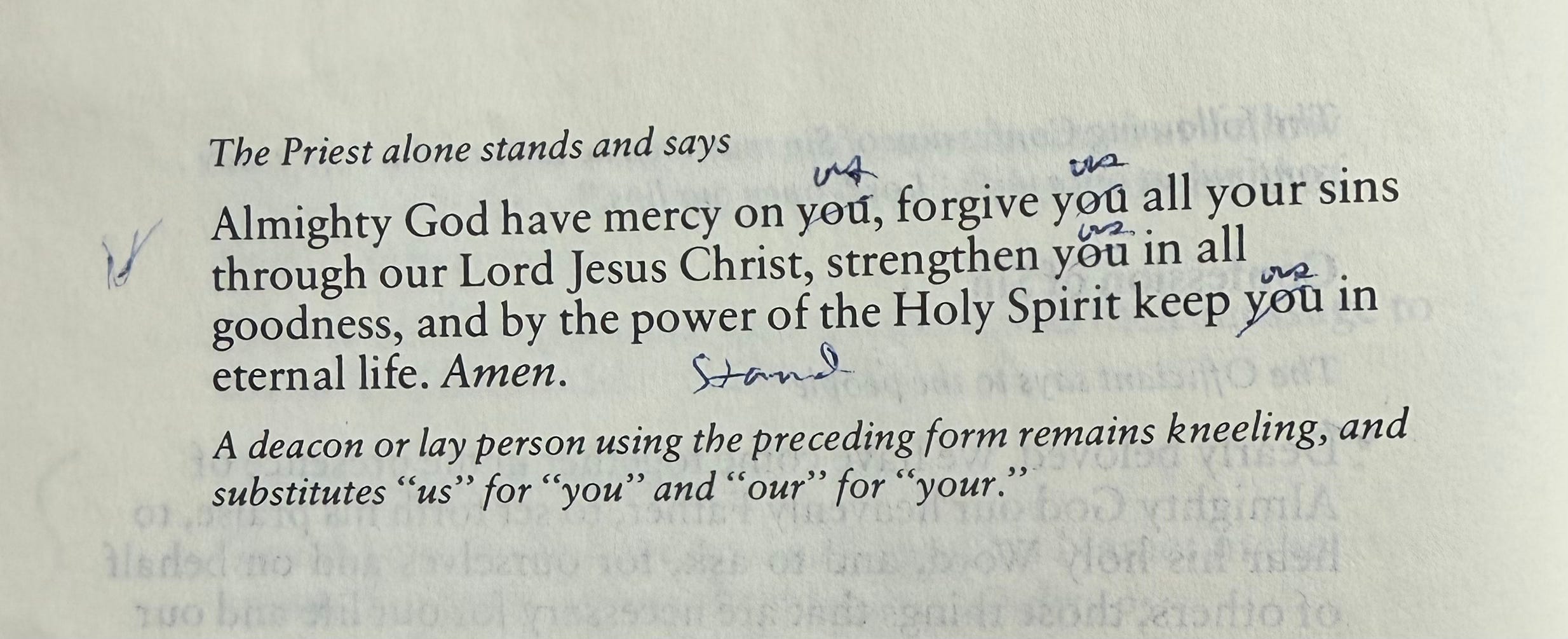
One of the first things I noticed, before more carefully reading the address to him by the priest, which revealed that he was a church warden (thus making my initial sleuthing efforts unnecessary), was that the word “you” had been crossed out by him in the absolution. I thought I was on to something. Only a priest or bishop says you, here. Instead, he penciled the word “us” above, and then he wrote “stand,” as if instructing himself. He took the postures seriously.
“The body ought to pray as well as the soul. Body and soul are both the better for it. Bless the body.” (C. S. Lewis)2
Billy John had his favorites. He liked the Jubilate (Ps. 100). My go-to is the Venite (Psalm 95:1-7). He liked Canticle 13, “A Song of Praise” (Benedictus es, Domine), a lovely choice. He preferred, as I do, the traditional version of the Lord’s prayer.
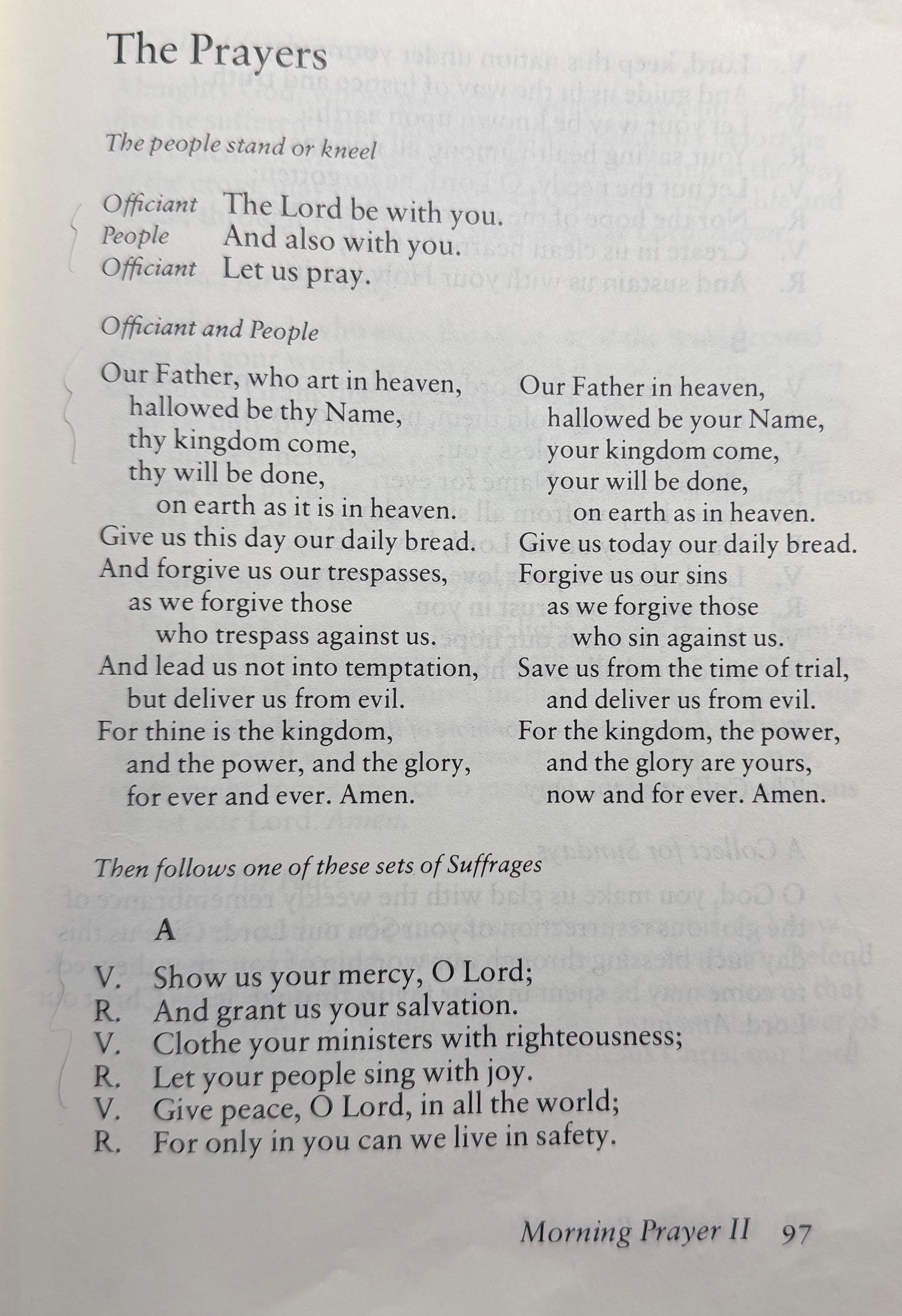
It strikes me, though, that even more than selecting favorites, his pencil marks, usually little checkmarks, were his way of learning to use this prayer book. He was making notes for ease of use. Under p. 127’s heading “An Order for Compline,” he penciled, all caps, “END OF DAY.”
I don’t know what happened to Billy John and why his BCP was sold online. Perhaps he is with the Lord. Perhaps not. I don’t know much about his life, as I said, but I know this: he took seriously the instructions of the priest who wrote, “Use this Prayer Book toward good spiritual health in Church and world.” This, whether Billy John ever saw it or not, is exactly what happened when he prayed. The Church and the world were changed in ways he could not understand. And now I have this book with prayer-saturated pages. It has been worked in with prayer.
When I pray, I feel like I am praying with Billy John. In fact, I am praying with Billy John. When I sit in the chair in my home office on these dark winter mornings and evenings, I am being shaped in prayer through the words of Scripture and Saints. I am joining my voice with “Angels and Archangels and all the company of heaven.” And with Billy John, too.
Henri Nouwen with Michael J. Christensen and Rebecca J. Laird, Discernment: Reading the Signs of Daily Life (HarperOne, 2013), 32.
C. S. Lewis, Letters to Malcolm: Chiefly on Prayer (HarperOne, 1963), 21.
I received my used BCP a few days before Christmas, with six ribbons! There are a few pencil markings but apparently not quite as personal as the ones you have found. I find it encouraging that there remains an impact from the prayers of those who have gone before us and that we sense them often in the places that they prayed. I hope to learn to pray in such a way that my devotion to Jesus will have a lingering impact beyond me, in ways beyond what I am able to find out. May it be like claiming territory for the kingdom of Jesus as the Israelites did with the Promised Land.